
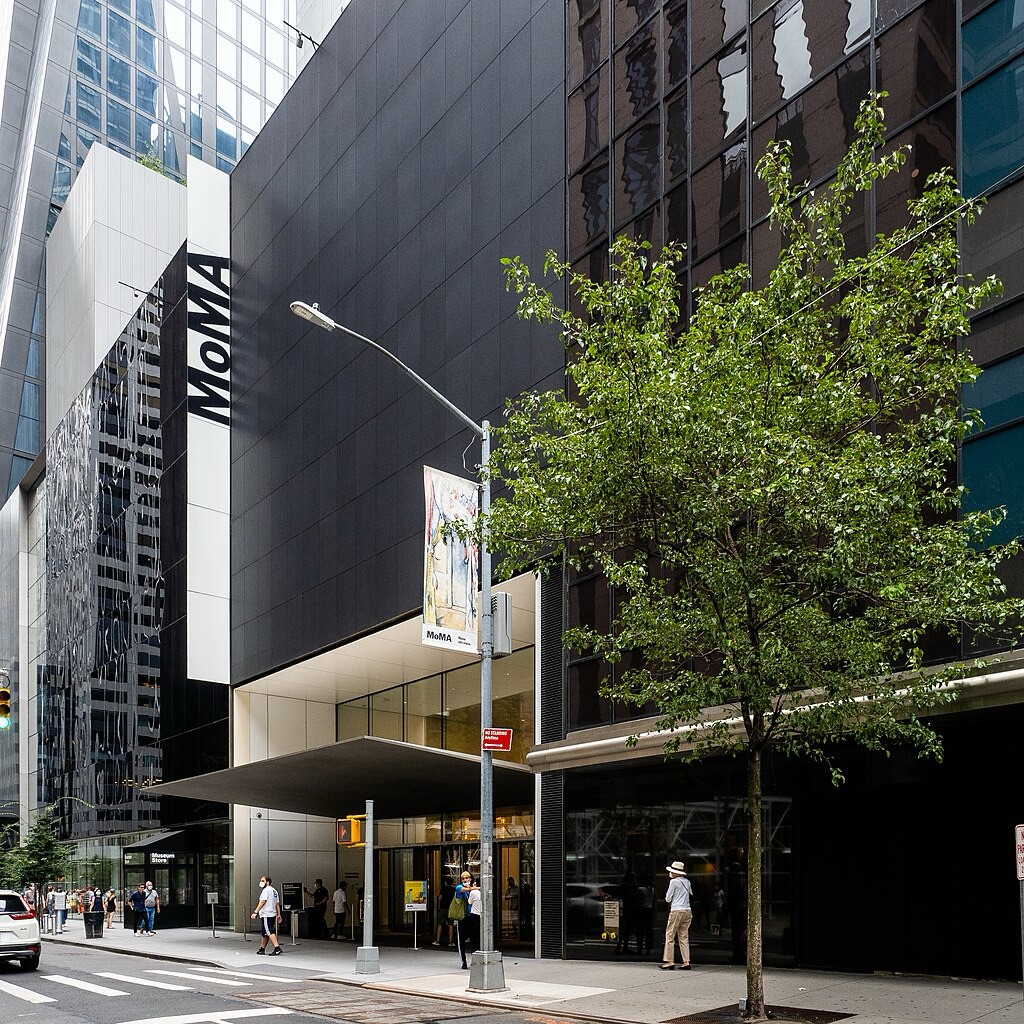
The Museum of Modern Art (MoMA) is an art museum located in Midtown Manhattan, New York City, on 53rd Street between Fifth and Sixth Avenues. The institution was conceived in 1929 by Abby Aldrich Rockefeller, Lillie P. Bliss, and Mary Quinn Sullivan. Initially located in the Heckscher Building on Fifth Avenue, it opened just days after the Wall Street Crash. The museum, America’s first devoted exclusively to modern art, was led by A. Conger Goodyear as president and Abby Rockefeller as treasurer, with Alfred H. Barr Jr. as its first director. Under Barr’s leadership, the museum’s collection rapidly expanded, beginning with an inaugural exhibition of works by European modernists. Despite financial challenges, including opposition from John D. Rockefeller Jr., the museum moved to several temporary locations in its early years, and John D. Rockefeller Jr. eventually donated the land for its permanent site.
From the 1930s through the 1950s, MoMA gained international recognition with landmark exhibitions, such as Barr’s influential “Cubism and Abstract Art” in 1936, a retrospective of Pablo Picasso‘s works organized in 1939–40 and the “Indian Art of the United States” exhibition in 1941. Abby Rockefeller’s son, Nelson, became the museum’s president in 1939, playing a key role in its expansion and publicity. His brother, David Rockefeller, joined the board in 1948 and continued the family’s close association with the museum. Significant events during this period included a major fire in 1958, which destroyed a painting by Claude Monet and led to the evacuation of other artworks. The museum’s architectural evolution also continued, with a redesign of the sculpture garden by Philip Johnson and relocation to its current home designed by Philip L. Goodwin and Edward Durell Stone, which opened in 1939.
In later decades, the controversial decision to withdraw funding from the antiwar poster “And Babies” in 1969, and the subsequent protests, highlighted the museum’s involvement in contemporary sociopolitical issues. It was also among several institutions to aid the CIA in its efforts to engage in cultural propaganda during the Cold War.[2] Major expansions in the 1980s and the early 21st century, including the selection of Japanese architect Yoshio Taniguchi for a significant renovation, nearly doubled MoMA’s space for exhibitions and programs. The 2000s saw the formal merger with the P.S. 1 Contemporary Art Center, and in 2019, another major renovation added significant gallery space.
 Bark Art Space
Leave a comment